



Saudi Arabia Leads Regional Reset: Trump–Shar’a Meeting Marks Turning Point in Middle East Diplomacy

Abdellah Mechnoune
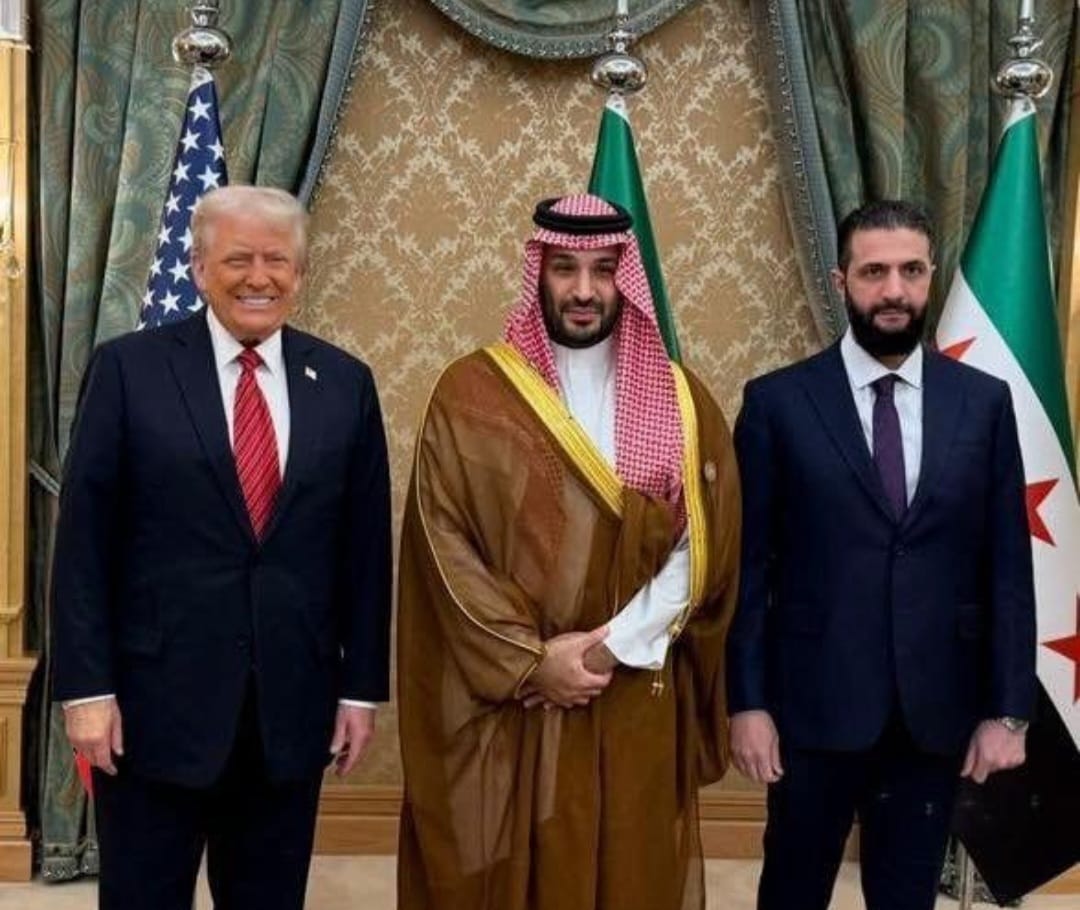
In a landmark diplomatic development, Saudi Arabia’s capital Riyadh hosted a historic meeting between U.S. President Donald Trump and Syrian President Ahmad Shar’a, on the sidelines of the Gulf-American Summit. This is the first direct meeting between leaders of the two nations in 25 years—a clear signal of shifting tides in regional politics, made possible through Saudi Arabia’s strategic leadership.
Under Crown Prince Mohammed bin Salman, the Kingdom has emerged as a driver of regional dialogue, pioneering a foreign policy rooted in opportunity rather than confrontation. The Trump–Shar’a encounter was no accident—it was the fruit of sustained Saudi diplomacy aimed at reintegrating Syria into the Arab fold and recalibrating global engagement with Damascus.
Riyadh, now a key node in international negotiations, has proven its capacity to engineer unlikely dialogues and bring together opposing forces for the sake of regional security and development.
At the heart of the meeting were critical topics: lifting sanctions, reconstruction, counterterrorism, and refugee repatriation. President Trump announced his decision to lift sanctions on Syria, framing it as a historic opportunity for Damascus to rebuild and reorient.
Shar’a, in turn, welcomed U.S. investment in Syria’s oil and gas sectors and expressed readiness to build a future free from international isolation, one grounded in cooperation and economic reform.
Saudi Arabia’s diplomatic weight was evident not only in hosting the encounter, but in facilitating the attendance of Turkish President Recep Tayyip Erdoğan, who joined virtually. Erdoğan underscored the need for a stable Syria that works with, rather than threatens, its neighbors.
This mediation effort reaffirms Riyadh’s growing role as a broker of regional stability and a platform for strategic realignment.
The Trump administration’s new approach departs from years of maximum pressure. Officials now view direct engagement with Damascus as a pathway to curbing extremism, managing detention camps in northeast Syria, and limiting Iran’s influence.
Sources also revealed discussions around economic arrangements, possibly including a symbolic “Trump Tower” in Damascus and preferential access to Syria’s energy markets—an indication of how diplomacy and commerce are converging.
Conclusion: Saudi Arabia as an Architect of Peace
The Riyadh summit signals the dawn of a new phase in Middle Eastern diplomacy—one driven by dialogue, development, and mutual interest. With Crown Prince Mohammed bin Salman at the helm, Saudi Arabia is no longer merely a regional power, but a global player shaping the post-conflict future of the region.
Trump’s meeting with Shar’a wasn’t just about Syria—it was about redrawing the map of influence in a region ready to move from crises to collaboration.
 English
 Español
 Deutsch
 Français
 العربية